Shopping for a property website in 2026 means wading through a crowded market where every platform has added AI features and every generic builder claims to work for real estate. This post compares five generic builders and five real estate platforms against Midtide. We are biased, but we will say clearly when something else is the better fit. All competitor pricing below was checked against each vendor's own pricing page on 8 August 2026.
What you get with Midtide
Generic website builders can technically build a real estate site. The same way you can technically use a screwdriver as a hammer. You can get there, but you are fighting the tool the entire time.
Midtide is built from the ground up for real estate. Every design decision, every feature, every default assumption in the product was made with an agent or agency in mind. The result is a platform that is genuinely fast to set up, looks professional without any design skill required, and ships with the tools agents actually need rather than a marketplace of third-party apps that may or may not work together.
There is a free tier with no credit card required, and paid plans that run from $24 to $48 a month depending on tier. No setup fee. And if you would rather not build it yourself, the support team will design and set the site up with you for free; you just have to ask.
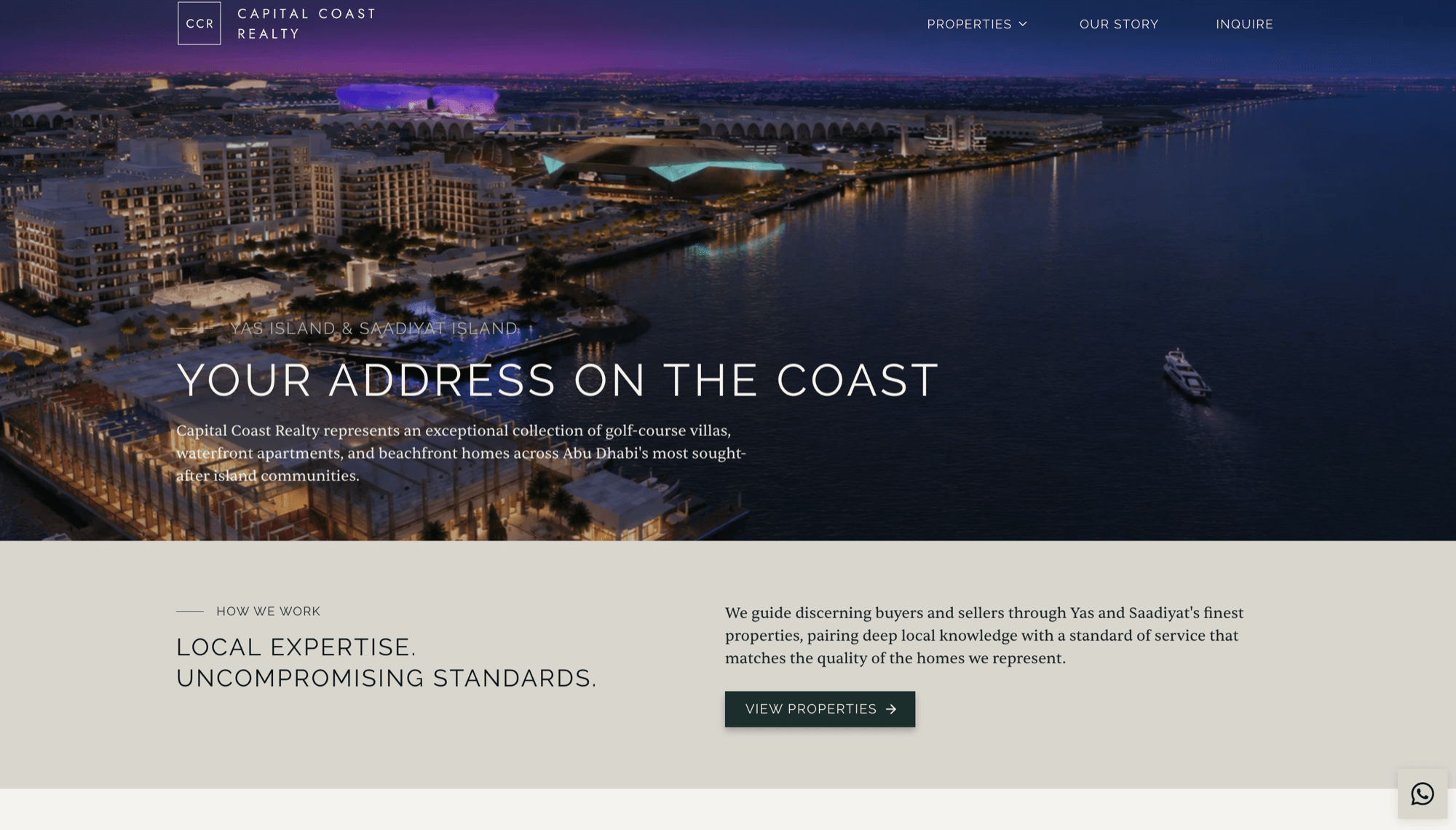
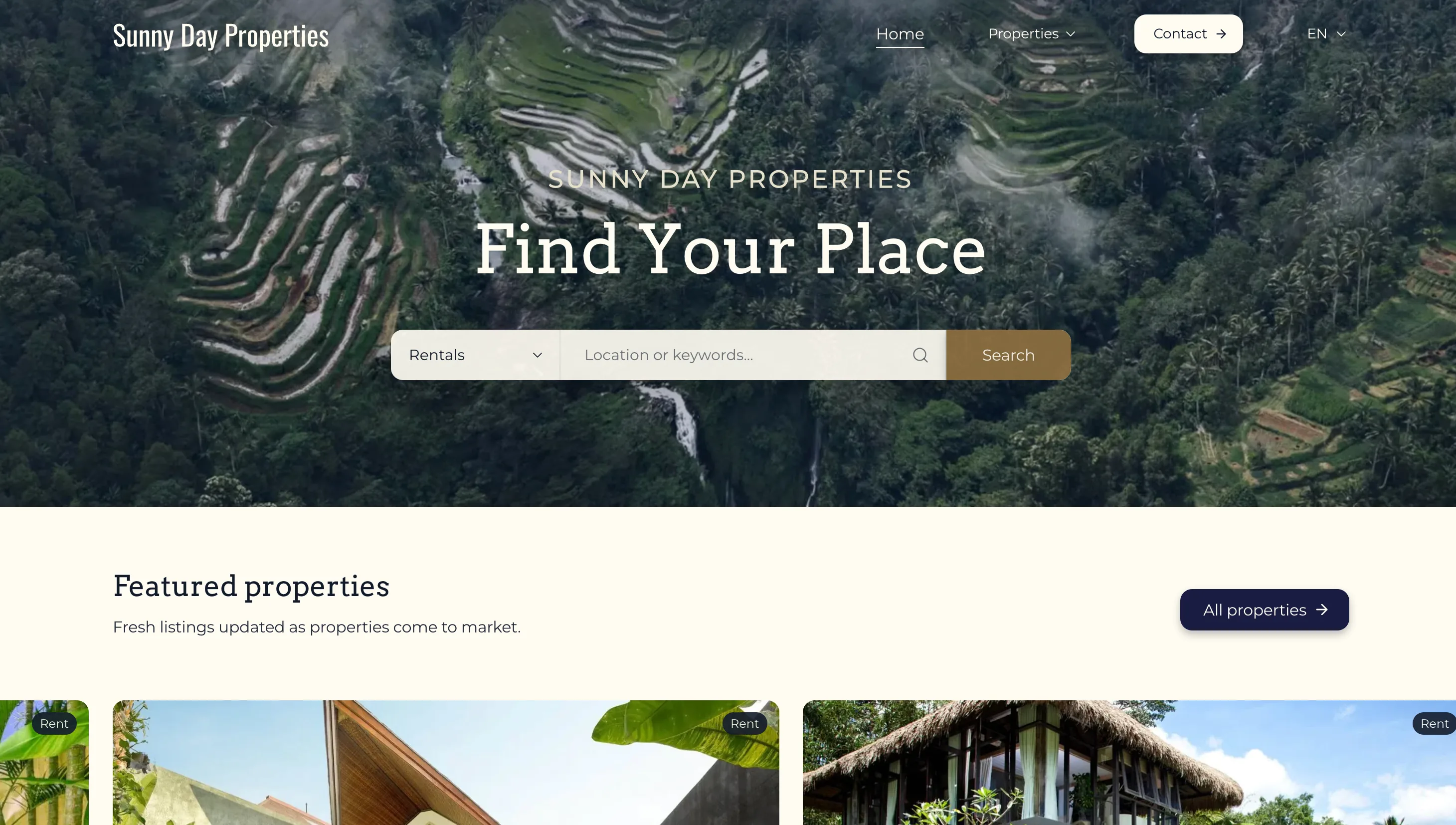
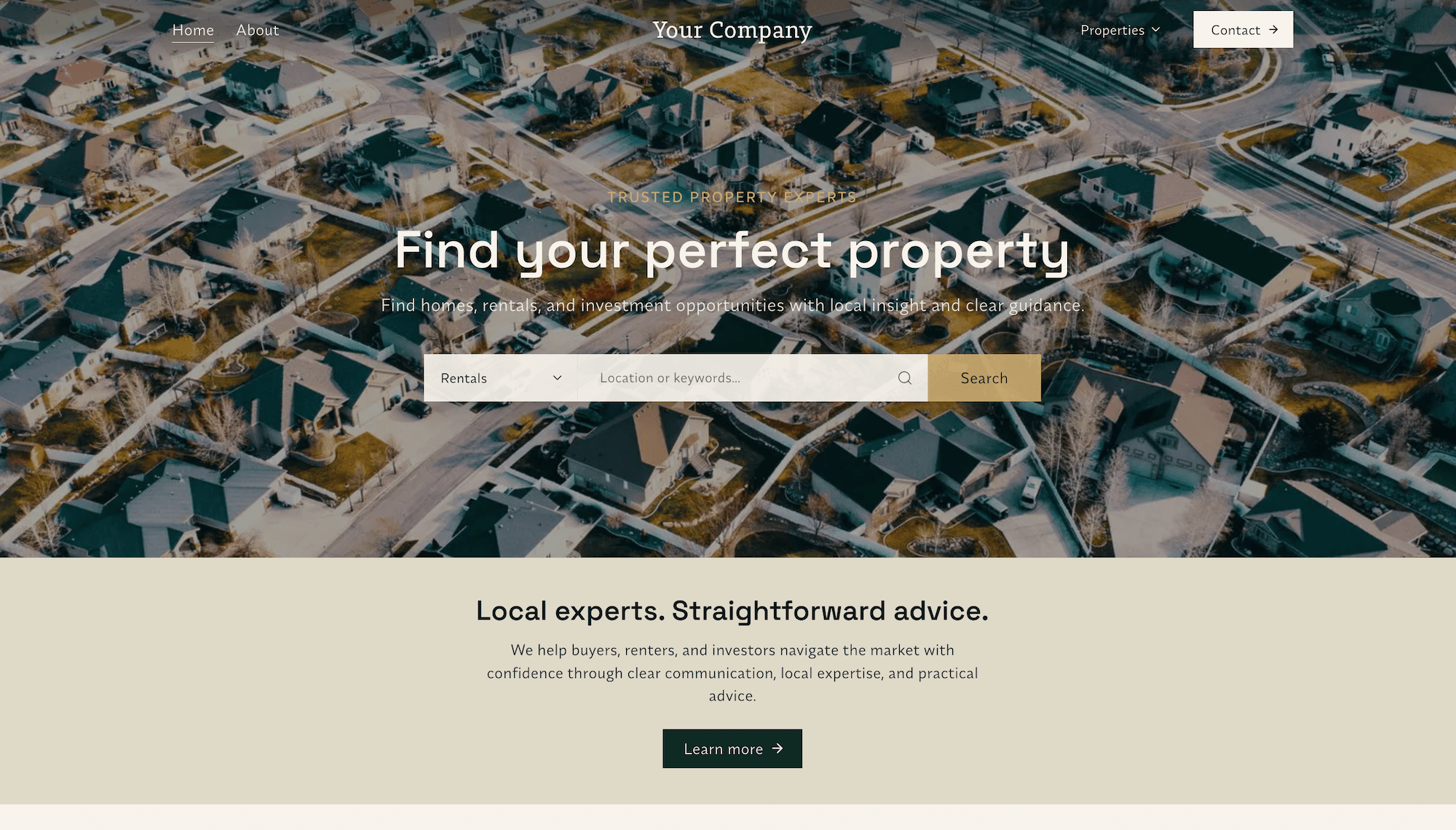
Design that looks the part from day one. Templates are built for property, not adapted from a generic theme library. Strong photography layouts, clean typography, and a visual standard that rivals sites costing ten times as much. No design experience needed to get there.
A property CMS built around how agents work. Add listings, manage photos, update prices, organise by location or type, and bulk import from a spreadsheet. Simple enough to update between viewings. Powerful enough to handle a full portfolio.
Real estate tools included as standard. Property search and filters, interactive maps, mortgage calculator, ROI calculator, live currency conversion across 33 currencies, photo galleries, lead capture forms, WhatsApp CTAs, Calendly integration, and blog pages. None of these are add-ons. None require a separate app or additional monthly fee. They are just there.
Lead management built in. Every enquiry from your contact forms and property pages lands in one dashboard, on a six-stage pipeline running from new through contacted, viewing, offer, and won or lost. Add notes, update status, filter by stage or assignee, and enter off-platform enquiries manually. Assign a listing to a team member and enquiries on that property route straight to them. Already on another CRM? Tell us which one and we will work with you on the integration.
AI Editor built in. Describe what you need in plain language and it builds it: a new page, a rewritten section, a blog post, a services block. Preview before anything goes live. No switching between tools, no copying and pasting.
AI translation across your whole site. One click translates listings, page copy, and content blocks into 12 languages, including right-to-left support for Arabic and Hebrew. Run it across your entire portfolio at once rather than property by property.
Connect your site to Claude. Securely connect your website to Claude and then run it by asking. Add a page, update a listing, draft a blog post, check this week's enquiries, add a note to a lead. You choose what Claude can reach, and you can revoke access from your dashboard at any time. No other platform in this comparison offers anything equivalent.
MLS integration for US agents. Live MLS listing sync is available for agents with a US MLS membership, as a $30 a month add-on per connection. Each agent connects their own membership and listings sync automatically. Midtide also connects to existing CRM systems via feed or API credentials.
Multilingual and multi-currency out of the box. 12 languages, 33 live currencies. Built for agents who work across borders or serve international buyers. Not required if you run an English only site. The full product is available either way.
Five generic website builders
These platforms can build almost anything. That flexibility is also the problem. None of them were designed with a property listing, a filterable search, or a CMS full of listings in mind. You can get there, but you are assembling it yourself.
Wix
Wix is the most widely known DIY builder available. It has a genuine AI site generator that asks questions about your business, then produces a complete site with layout, copy, images, and branding in minutes. Post-launch, you can use AI to regenerate or edit any copy block without leaving the editor. It also has AI SEO tools that generate meta titles, descriptions, and keywords automatically.
For a general business site, all of this works well. For real estate specifically, the limitations become apparent quickly.
Property listings are not a native content type in Wix, and the limitation is explicit rather than incidental: Wix's own help centre states that it does not support IDX integration. You add listings through third-party apps from the Wix App Market, and the quality of those apps varies significantly. For MLS data Wix directs agents to iHomefinder, which does not publish tier pricing and requires a sales call; its published figures are a $500 website setup fee and $25 to $50 a month for additional MLSs. Filters, interactive maps, mortgage calculators, and enquiry routing each come from different apps that may or may not match your design or work together cleanly.
Wix's AI can write copy and generate pages. It cannot create a purpose-built property CMS, wire up a listing search that understands what a bedroom filter is, or translate your portfolio into Indonesian with one click. You end up building real estate features onto a platform that was not designed for them.
Squarespace
Squarespace wins on aesthetics. Clean typography, strong templates, genuinely good for brand pages and agent profiles. Basic is $19 a month and Core $29 billed annually, following a price rise in July 2026 that many comparison articles have not yet caught up with. For property as a content type it falls short in the same way as Wix, just with less flexibility. There is no listing CMS, no filtered property search, no mortgage calculator, and no per-listing structured data. Most agents end up with a well-designed homepage that links out to Rightmove, Zillow, or a local portal. Fine if you treat your website as a brand presence. Not fine if you want inventory to actually live there.
WordPress
WordPress can do almost anything, which is why many agencies still use it. Two products are worth separating: WordPress.com hosted starts at $4 a month, but you need the Business plan at $25 before you can install the plugins any real estate build requires, while self-hosted WordPress.org is free software on hosting that typically runs $3 to $10 a month introductory and $10 to $18 on renewal. Real estate themes exist, IDX plugins can pull MLS data, and a capable developer can build something genuinely custom. You are also signing up for ongoing hosting, plugin updates, theme conflicts, and security patches. A properly maintained WordPress property site costs time every month even after launch, whether that is yours or a developer on retainer. The flexibility is real and so is the overhead.
GoDaddy
Fast, cheap, and hard to break, at $9.99 a month billed annually. Two cautions: monthly billing is $21.99, and annual renewal rises to around $16.99, the steepest renewal jump of the builders here. Good as a placeholder while you get started, or a single page with your phone number and a portal link. Does not work if you have 40 active listings, photo galleries, filters, and enquiry forms to manage.
Webflow
The designer's choice. Pixel level control and a CMS for structured content. Note that the Basic plan at $15 a month has no CMS at all and cannot hold listings, so the real entry point is Premium at $25 a month, which allows 20,000 CMS items; Webflow merged its old CMS and Business plans in May 2026, so the previous 2,000-item limit no longer applies. With a skilled designer you can build a strong property site. Without one the learning curve is steep. You still need to model properties as CMS items, design the listing detail page, wire up filters, and build search yourself. Budget for the designer, not just the subscription.
The pattern across all five is the same: you can build a property site, but you are assembling it. Midtide ships it ready.
Five real estate website builders
These platforms understand what a real estate agent needs. They are also almost entirely built around the US market and MLS data infrastructure. Pricing reflects that.
Placester
Placester is the most direct competitor worth examining honestly. It launched an AI website builder in late 2025 that scans your existing online presence including listings, reviews, and bio and generates a complete site in minutes. Its AI editor works through conversation: describe what you need and it builds or rewrites it, showing a preview before anything goes live. Agents can use it to generate blog posts, area pages, and landing pages at speed. It also has deep MLS integration across hundreds of boards, a built-in CRM, and email marketing tools.
Both Placester and Midtide now offer MLS sync, a conversational AI editor, and built-in lead management. Where they diverge is depth, audience, and pricing. Placester is built around MLS-first workflows and US residential agents, with drip email campaigns and lead scoring bundled into a heavier CRM suite. That is genuinely useful if you need it, and the pricing reflects it: Agent Essential is $59 a month plus $25 a month per MLS contract, so $84 all in, with Plus at $79 and Premier at $129. Midtide covers the same MLS sync for US agents, adds pipeline tracking, notes, and status updates in the dashboard, plus multilingual CMS and multi-currency display for international markets, from $24 a month with a free tier to start on. If you need drip automation and lead scoring inside the same platform, Placester has an edge, and at $84 a month it is the best value of the MLS-first platforms. If you want lead management without paying for marketing automation you will never use, Midtide is the stronger fit at a third of the price.
Luxury Presence
Premium end of the US market. Custom-designed sites, marketing tools bundled in, and an AI-powered CRM. Pricing is not published: their pricing page lists four plans plus enterprise and discloses only advertising budget ceilings of $1,000, $5,000 and $10,000, so expect a sales call and a twelve-month agreement. Genuinely excellent if you are a high-volume US luxury agent who can justify the cost. Not relevant to independent agents or boutique agencies outside that market.
Real Geeks
Established US all in one: IDX search, lead capture, and a competent CRM. $399 a month plus a $500 one-time setup fee, with two users and your first MLS board included and extra boards at $10 a month. The most straightforward pricing in the category. Solid and proven for US residential agents who need MLS search as the core of their site.
AgentFire
Brand-forward agent sites with IDX integration, and the best-looking sites of the US IDX platforms. The Pro plan is $165 a month, but a design package is mandatory, starting at $800 and rising to $6,500, so realistic first-month cost is around $965 rather than the advertised monthly rate. IDX is included but excludes MLS pass-through fees. Strong on design and neighbourhood-level content pages. US-centric and priced with that market in mind.
Sierra Interactive
Built for teams and brokerages: IDX, CRM, drip email campaigns, and an AI assistant for lead follow-up. Starter is $299.95 a month billed annually, or $359.95 month-to-month, and the annual option also waives a $500 setup fee. Budget separately for the dialer at $100 a month and the Lead Engage AI assistant at $199 a month, both commonly assumed to be included. Designed for operations running significant lead volume, not independent agents.
AI features: an honest comparison
AI is now part of every serious platform's pitch. It is worth being specific about what each one actually offers.
Wix has an AI site generator that produces a complete site from a brief, AI text tools for editing copy, and AI SEO tools for meta content. These are general purpose tools that happen to be available on a platform you can use for real estate.
Placester has a conversational AI editor that generates pages, blog posts, and landing pages through chat. It is purpose-built for real estate copywriting and content workflows within a US MLS context.
Midtide's AI Editor works the same way conversationally, creating pages, rewriting sections, and drafting blog posts through plain language instructions, with a preview before anything goes live. On top of that, Midtide adds AI translation across 11 languages in one click, which neither Wix nor Placester matches at the level of a purpose-built multilingual CMS. For agents outside the US and UK, that distinction matters significantly.
At a glance
| Platform | From | Setup fee | Property CMS |
|---|---|---|---|
| Midtide | $24/mo | None | Yes |
| Placester | $59/mo + $25 per MLS | None required | Yes |
| AgentFire | $165/mo | $800 to $6,500 required | Yes |
| Sierra Interactive | $299.95/mo annual | $0 annual / $500 monthly | Yes |
| Real Geeks | $399/mo | $500 | Yes |
| Luxury Presence | On request | Undisclosed | Yes |
| GoDaddy | $9.99/mo | None | No |
| Wix | $17/mo | None | No |
| Squarespace | $19/mo | None | No |
| Webflow | $25/mo (Premium) | None | No |
| WordPress.com | $25/mo (Business) | None | No |
US pricing, entry tier, billed annually where offered. Monthly billing costs more on most platforms.
- Listings. Generic builders: manual entry or third-party apps. US platforms: MLS and IDX sync. Midtide: your own CMS, spreadsheet import, XML feed from your CRM, or live MLS sync for US agents.
- Design. Midtide and Luxury Presence look premium out of the box. Generic builders need significant work to get there. US IDX templates tend to look similar to each other.
- Agent features. Search, filters, interactive maps, mortgage and ROI calculators, multi-currency, multilingual, WhatsApp CTAs, Calendly, blog pages, and a built-in lead pipeline all ship with Midtide. On generic builders you build or buy each piece separately.
- Leads and CRM. Midtide tracks enquiries in a dashboard with notes and status updates, plus optional connections to your existing CRM. US platforms add drip email, lead scoring, and heavier marketing automation on top.
- AI tools. Wix and Placester both have AI editors. Midtide adds AI translation at the CMS level and a Claude integration, neither of which any other platform here offers as a native feature.
When Midtide is not the right answer
If you need enterprise CRM with drip email campaigns, lead scoring, and automated follow-up sequences as the core of how you run sales, the US platforms handle that better. Midtide includes lead capture, pipeline tracking, and notes in the dashboard. It is not a full sales operating system with marketing automation baked in.
If your MLS is not yet in Midtide's aggregator coverage network, there will be a wait while that feed is added. Get in touch and we can check your MLS before you sign up.
Common questions
How much does Midtide cost?
There is a free tier with no credit card required. Paid plans run from $24 to $48 a month depending on tier, with no setup fee. Higher tiers raise the property limit and add team seats. US IDX/MLS is a separate add-on at $30 a month per connection.
Is Midtide better than Placester?
It depends on where your listings come from. Placester is better if you are a US agent working from MLS data and want drip email campaigns and lead scoring bundled in, at $84 a month all in. Midtide is better if you manage your own listings, work in more than one language or currency, or want to run your site through Claude, and it starts at roughly a fifth of the price.
Does Midtide support MLS or IDX?
US agents can add an MLS/IDX connection for $30 a month per connection, arranged per board. If your listings are your own, they live in Midtide's property CMS instead, with spreadsheet import for bulk uploads. Get in touch and we can check your board before you sign up.
Can I use Wix or Squarespace for a real estate website?
You can, but neither has a property CMS. Wix's own help centre states it does not support IDX integration, and Squarespace has no filtered listing search. Both work well if your site is a brand presence and your listings live on a portal. Neither works well if you want inventory on your own site.
Does Midtide include a CRM?
Yes, a lightweight one. Enquiries land in a dashboard on a six-stage pipeline from new through contacted, viewing, offer and won or lost, with notes, manual entry, filtering, and assignment to a team member. Enquiries on a property route automatically to its assigned agent. It does not include drip email campaigns or lead scoring; if those are central to how you sell, the US platforms handle them better.
How many languages and currencies does Midtide support?
12 languages with one-click AI translation across your whole portfolio, including right-to-left support for Arabic and Hebrew, and 33 currencies with live conversion. A single site can display up to four currencies at once.
Can I connect Midtide to Claude?
Yes. You can securely connect your site to Claude and edit pages, manage listings, draft blog posts and review leads by asking. You choose what Claude can reach, and you can revoke access from your dashboard at any time.
The bottom line
Generic builders are flexible but you will spend significant time assembling the property features that Midtide ships on day one. US real estate platforms are purpose-built but expensive, and most bundle a heavy marketing CRM whether or not you need one. Placester is the closest competitor in terms of AI capability and real estate focus, and at $84 a month all in it is the one we would recommend over Midtide if you want drip campaigns and lead scoring in the same subscription.
Midtide sits in the middle: purpose-built design, a CMS you will actually use, lead management in the dashboard, AI tools built in rather than bolted on, a Claude integration no one else offers, multilingual and multi-currency as standard, MLS sync available for US agents, and pricing from $24 a month that does not require a sales call to understand.
Want to see it working on your own listings? Start for free or get in touch about MLS integration or your market. For a vendor-neutral look at the same platforms, see the best real estate website builders in 2026.